
150th Bayreuth Festival

(18, 19 & 20 August 2026)
The Varnished Culture finally got into Bayreuth (two trains, one bus via Pegnitz) and stayed at the funky Liebesbier Urban Art Hotel.
The original Festival took place from 13 to 17 August 1876. The beautifully-mad King Ludwig funded the Festspielhaus. Wagner, writing in his autobiography (Volume 2), said “the dangerous road along which fate beckoned me to such great ends was not destined to be clear of troubles and anxieties of a kind unknown to me heretofore, but I was never again to feel the weight of the everyday hardships of existence under the protection of my exalted friend.”


On the rainy evening of 18 August, we had The Flying Dutchman. But it was not the traditional type of production as evidenced by the model displayed at Wahnfried (below):

Our hearts sank a tad when we noticed that the piece had been ‘re-imagined’ by one Dimitry Tcherniakov, who previously strangled, mutilated and cremated Parsifal for the Berliner Staatsoper. In the words of Roger Scruton, “In the climax of Act III Parsifal, having led Amfortas and Kundry to each other so that they can snog in A flat major, sinks into the background, a smiling voyeur. The scene ends when the incensed Gurnemanz, to the relief of every decent Wagnerian in the audience, plunges a knife into Kundry’s back.”

In this staging of Der fliegende Holländer, Tcherniakov brings us his artistic pyromania, his sets a cross twixt Edward Hopper and Eugene O’Neill, in which we have neither ghosts, nor ghost ship; the whole piece entirely ‘land-locked’; a hanged coquette dangles during the overture; the town is set on fire; the supernatural, mythical elements exchanged for a squalid revenger’s tale; and shots are exchanged with rifles and handguns at the close. The staging is bizarre, and no pompous programme’s gibberish can bring much enlightenment. However, there can be no quibbling with the singing, or the orchestration conducted by the tiny Oksana Lyniv (albeit with some musical ‘jump-cuts’), which were superb.


“What did you make of that?”
August 19 gave us Rienzi (Hitler’s ‘favourite’), a rousing story (based on Bulwer-Lytton’s novel) of the Roman nobleman who is elected by popular acclaim, only to be cut down by the same hoi polloi. The sets were apt, with good use of large screens and smartphones, and walls plastered with propaganda, emphasizing the political themes (one townsfolk’s sign read “Make Rome Great Again”), cleverly implying the fickle nature of mobs (once the election was over, they returned to their hovels to watch a soccer game on TV).

There are some odd touches that don’t seem entirely coherent (once again, we smelt the burning-flesh influence of that damned Russian, Mr. Tcherniakov – we could be wrong – but was that not him on stage at the conclusion?) Examples include a domestic back-story tragedy presented during the overture; a gratuitous (same sex) kiss; and a bunch of fatal stabbings rather than the conflagration dictated by the Maestro’s libretto. But the tinkering, unlike Dutchman, did not serve to detract from the overall vigour of the production. The battle scenes were impressive. The dead soldiers looked authentically dead.
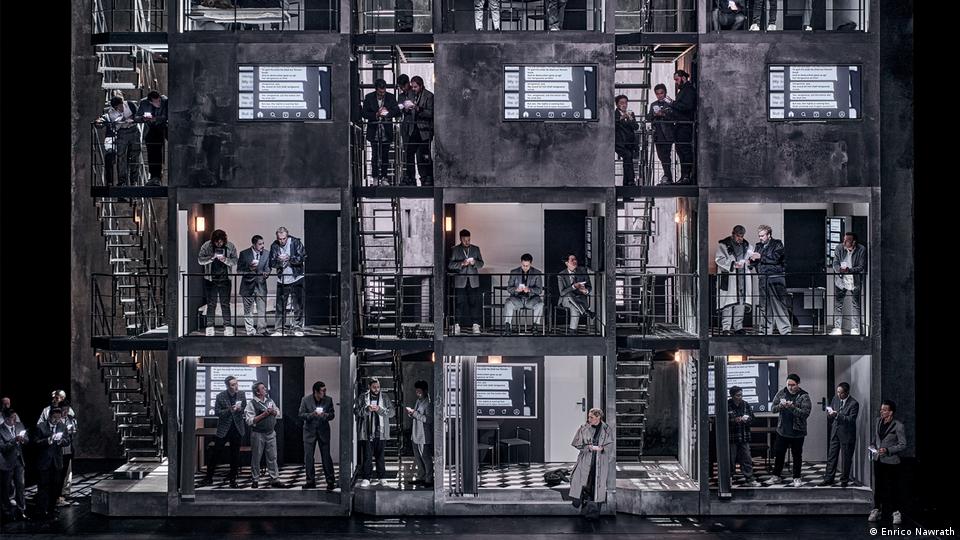
The ballet is a highlight, featuring some funny business, a show put-on for the new Tribune, in the form of a comic pantomime of Wagner hits – The Ring, Lohengrin, Tannhäuser, Tristan und Isolde, Die Meistersinger von Nürnberg, and Parsifal. This viewer initially thought such a touch was too cute, too clever, but then he remembered the line from Seymour Glass in Franny & Zooey (cleverness can be an affliction and it is in bad taste to draw attention to it). The Fourth Act begins with Rienzi’s prayer, which should open the Fifth. Everyone is knife-happy at the end; meanwhile, TVC was annoyed by the cast’s applause-wringing curtain calls at the end of Acts II, III & IV.

Andreas Schager struggled a bit but carried off a difficult role. Gabriela Scherer (Irene) was adequate without being lyrical, especially on the highest notes. Jennifer Holloway was an excellent Adriano.
The supporting cast were very good. The choir of the Bayreuther Festspiele under Thomas Eitler-de Lint and the Festspielorchester under Nathalie Stutzmann were splendid. Wagner’s music was at times a little callow, with echoes of the greatness to come. But callow Wagner is still better than the best of most.
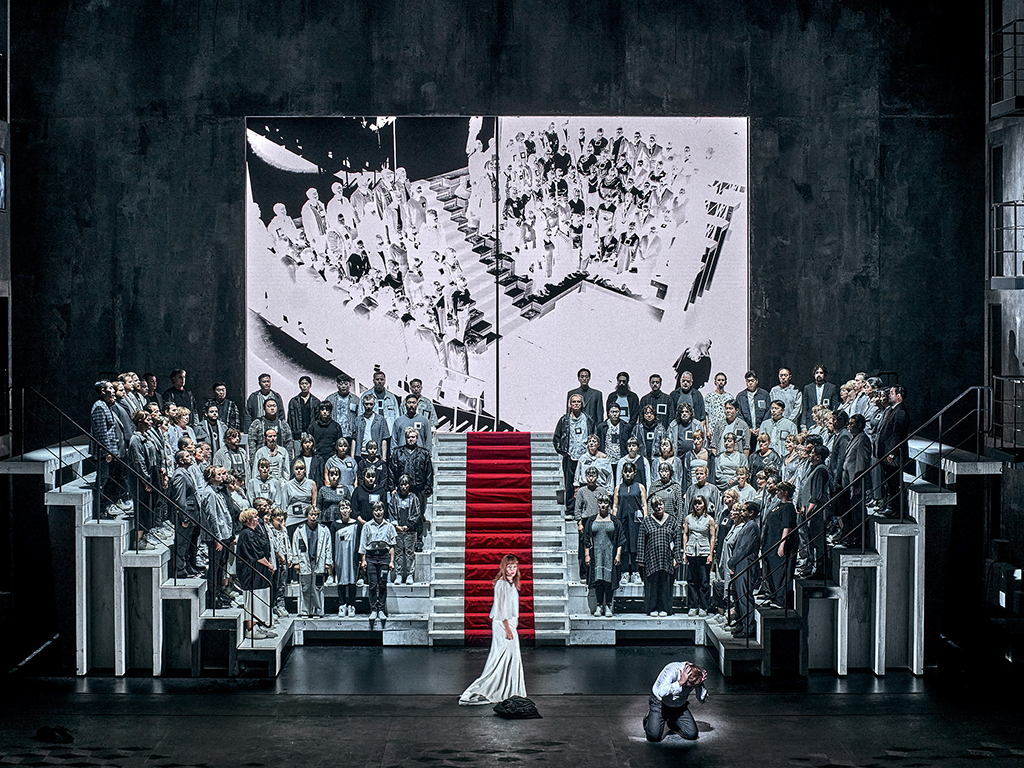
All too late, Rienzi finds that glory is fleeting and you can’t please everybody, especially if you forgive your enemies (cf. President Trump). Rienzi authentically loses the plot in the end (all political careers tending to end in failure) but we couldn’t really accept the stabbings, in the final analysis.
Whilst Wagner didn’t want Rienzi staged in Bayreuth, it seems right to do so in the 150th year, especially for those Wagnerians who have not seen it. It was enthusiastically received by the capacity crowd, deservedly so.


It was a fitting finale for our stay in Bayreuth.

Leave a comment...
While your email address is required to post a comment, it will NOT be published.

1 Comment